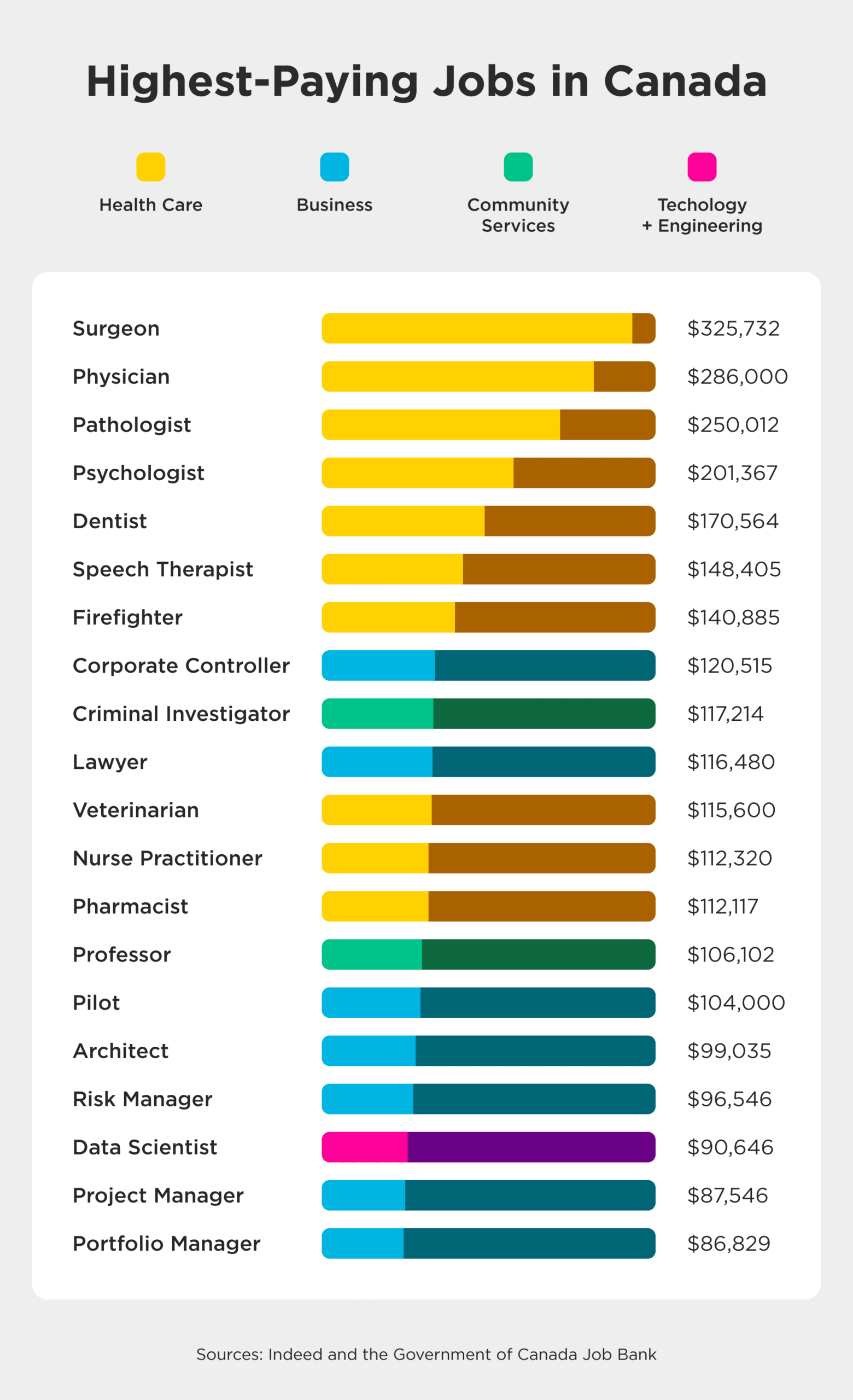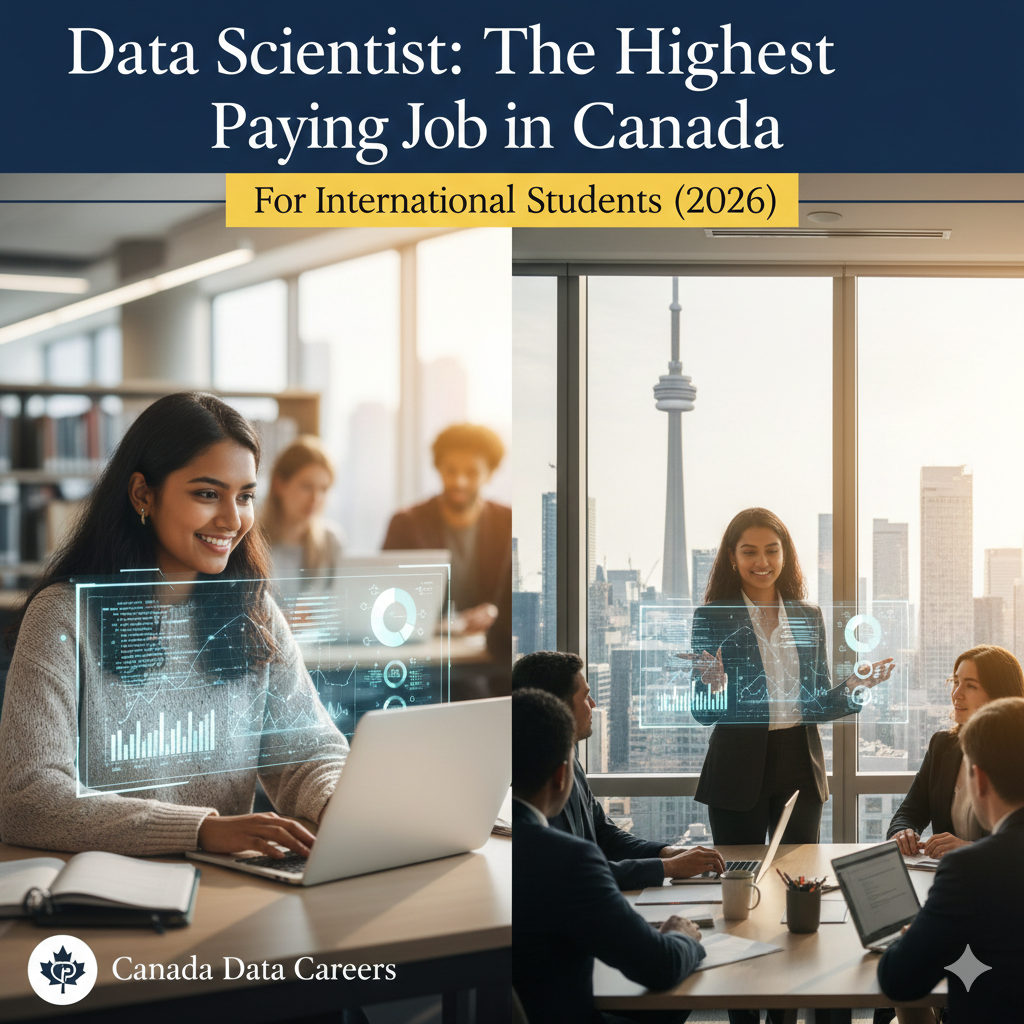
For many international students, attending school in Canada means more than just earning a globally recognised degree. It’s also about making a living that has a lot of potential for growth, long-term stability, and excellent pay. As we get closer to 2026, one job stands out in universities, employers, and sectors that are friendly to immigrants: Scientist of Data.
If you’ve ever wondered what job in Canada pays well, is important around the world, and is in high demand for international graduates, you’re in the right place. This guide explains why data science is the highest-paying job path for international students, what the job actually entails, how much you can realistically expect to make, and how to set yourself up for success after graduation.
You don’t need to know a lot about technology to understand this article. Everything is clearly explained, step by step, with examples from real life that make sense.
Why career choices matter more for international students
International students often have to pay more for school, rent, and living expenses, and they feel more pressure to find a lucrative job after graduation. It can be hard later on if you choose a course of study without a clear career path.
That’s why degrees that help you get a job are important. Data science is the point where technology, business, healthcare, finance, and public policy all meet. It’s not a niche job. It is a basic skill set that modern businesses use to make choices.
The answer is simple: students who learn data science are entering a job market that needs them right now.
Could you please explain what a data scientist does?
The job title of “data scientist” gets a lot of attention, but the work itself is surprisingly practical.
A data scientist helps businesses understand data so they can make better choices. This includes:
- Gathering a lot of both structured and unstructured data
- Cleaning and organizing that data so it can be used
- Finding patterns with the help of statistical models and algorithms
- Using statistical models and algorithms to identify patterns
- Making technical findings into insights that decision-makers can use
In everyday terms, data scientists answer questions such as, ‘Why are customers leaving?’
Which products should we invest in?
How can we lower costs or make services better? If things keep going the way they are, what will probably happen next?
This problem-solving nature is one of the reasons the role pays so well. Companies are not paying for codes alone. They are paying for insight.
Why data science pays so well in Canada
When demand is higher than supply, salaries tend to be high. That’s exactly what’s going on in Canada’s data and analytics industry.
There are several reasons for this.
To start, Canada is putting a lot of money into digital transformation. Data-driven decision-making is now necessary for everything from banks and hospitals to transport systems and government services.
Second, there aren’t many data professionals with a lot of experience. Many people learn the basics of IT or computer science, but not as many graduate with the advanced analytical skills needed for data science jobs.
Third, international students often have different points of view, higher education, and strong analytical skills, which makes them very valuable to companies that do business around the world.
When you put these things together, employers are willing to pay more to find and keep good workers.
Average salary of a data scientist in Canada (2026 outlook)
Salaries differ by province, experience level, and industry, but data science is always one of the best-paying jobs for new graduates.
Typical salary ranges include:
- Entry-level data scientist: CAD 75,000 – 95,000
- Mid-level data scientist: CAD 100,000 – 130,000
- Senior data scientist or specialist: CAD 140,000 – 180,000+
Some jobs in finance, AI, and advanced analytics pay more than these ranges, especially when bonuses or stock-based pay are included.
For students from other countries, this level of income can help them pay for school and reach their long-term goals of settling down.
Industries in Canada hiring data scientists aggressively
Data science excels in various fields. This flexibility makes it easier to move around and keeps your job secure.
Major hiring industries include:
Technology and software
Companies rely heavily on data scientists to improve products, user experience, and system performance.
Finance and banking
Banks and other financial institutions use data science to find fraud, figure out how risky something is, tailor services to individual customers, and predict how markets will behave.
Healthcare and life sciences
Data science helps with medical research, planning for public health, improving patient outcomes, and making healthcare more efficient.
Retail and e-commerce
From pricing strategies to customer behavior, data drives every major retail decision.
Government and public services
More and more, public-sector groups depend on data scientists for things like policy evaluation, resource allocation, and digital services.
This cross-industry demand allows for flexibility in your career path post-graduation.
Why international students have an edge in data science
International students often assume employers prefer local candidates. In data science, skills matter more than nationality.
Employers prioritize:
- Strong analytical thinking
- Applied problem-solving ability
- Experience working with real datasets
- Clear communication of insights
If you demonstrate these effectively, your background becomes an asset, not a barrier.
In fact, many Canadian employers like hiring international graduates because they have a global view and advanced academic training that works well with data-driven jobs.
Best degrees to become a data scientist in Canada
There is no single “perfect” degree, but certain study paths consistently lead to data science roles.
Common academic backgrounds include:
- Data Science
- Computer Science
- Statistics
- Mathematics
- Engineering
- Information Systems
- Artificial Intelligence
What matters most is not the degree title but the skills you build during your studies.
Courses involving statistics, programming, machine learning, data visualisations, and real-world projects are particularly valuable.
Essential skills every aspiring data scientist needs
A degree alone is not enough. Employers look for a blend of technical and non-technical skills.
Key technical skills include:
- Programming languages such as Python or R
- SQL and database querying
- Statistical analysis and probability
- Machine learning fundamentals
- Data visualization tools
Equally important soft skills include:
- Communication and storytelling with data
- Critical thinking
- Business understanding
- Ethical use of data
Students who intentionally develop both sets of skills stand out quickly in the job market.
Can non-technical students transition into data science?
Yes, and this surprises many people.
Students who study economics, business, social sciences, or even natural sciences often do well when they switch to data science. The most important thing is to work on your analytical thinking and learn the technical tools slowly.
Many employers like it when people know a lot about a certain area and can work with data. A student who knows about healthcare systems and data analytics may be more valuable than a candidate who is only good at technical skills and doesn’t know anything about the industry.
Work opportunities during and after studies
One of Canada’s strengths is its student-friendly work policies.
International students are typically allowed to work part-time during studies and full-time during scheduled breaks. For data science students, this opens doors to:
- Research assistant roles
- Data analyst internships
- Co-op placements
- Junior analytics positions
These things are important. Even a little time spent working with real datasets can make it much easier to find a job after graduation.
Many students can get full-time work experience in Canada after they finish their programs, which improves their long-term job prospects even more.
Immigration pathways and long-term stability
This article is mostly about careers, but it’s also important to know why data science is a good fit for long-term plans.
Because there aren’t enough people with the right skills, jobs that involve data are often on lists of jobs that are in high demand. Over time, this makes them able to work in various skilled worker fields.
That being said, immigration rules can change, and there is no guarantee of a certain outcome. Always think of career planning and immigration planning as two different but related things.
Common myths about data science careers
Let’s clear up a few misconceptions.
You must be a math genius
You need logical thinking and basic statistics, not extraordinary mathematics skills.
Only top universities matter
Employers care more about skills, projects, and experience than the name of the institution.
It is only for programmers
Programming is a tool, not the entire job. Insight and problem-solving matter more.
The field is overcrowded
Entry-level roles can be competitive, but skilled data scientists remain in short supply.
Understanding these realities helps set realistic expectations and reduces unnecessary anxiety.
How to stand out as an international student
Students who succeed usually take a proactive approach rather than waiting until graduation.
Practical steps include:
- Working on real-world data projects
- Building a portfolio that shows your thinking process
- Participating in internships or research roles
- Improving communication and presentation skills
These actions matter more than applying to hundreds of jobs blindly.
Ethical and responsible use of data
Modern data science is not just about technical results. Ethical considerations are increasingly important.
Employers expect data scientists to:
- Respect privacy and data protection standards
- Avoid biased or misleading analysis
- Communicate limitations honestly
Understanding these responsibilities strengthens your professional credibility and aligns with global best practices.
Is data science right for you?
Before committing to this path, ask yourself a few simple questions.
Do you like working with data and patterns? Are you okay with always learning? Do you like working on problems that don’t have a clear answer?
If the answer is yes, data science is probably a beneficial fit.
If you like doing the same things over and over again or don’t like thinking analytically, you might be happier in a different job.
The future outlook for data scientists in Canada
In the years leading up to 2026 and beyond, we expect data scientists’ jobs to grow, not shrink.
Data-driven models are essential for digital services, automation, and artificial intelligence. As systems get more complicated, there is a greater need for skilled people who can understand and guide them.
Automation doesn’t usually replace data scientists; instead, it often makes more people want higher-level analytical jobs.
Final thoughts: A career that rewards skill and strategy
Data Scientist is the highest-paying job in Canada for international students, and it’s not just because of hype. This is due to the consistent demand for it, its diverse applications, and its quantifiable impact on business.
Students who are willing to spend time and money on useful skills, real-world experience, and ongoing learning can get a lot out of it. In a job market that is becoming more competitive around the world, data science is a great choice because of its high pay, many career options, and long-term growth potential.
There is no job that guarantees success, but data science is unique in that it aligns education, income potential, and future relevance.
This is a path worth considering if you are planning your studies with both opportunity and sustainability in mind.